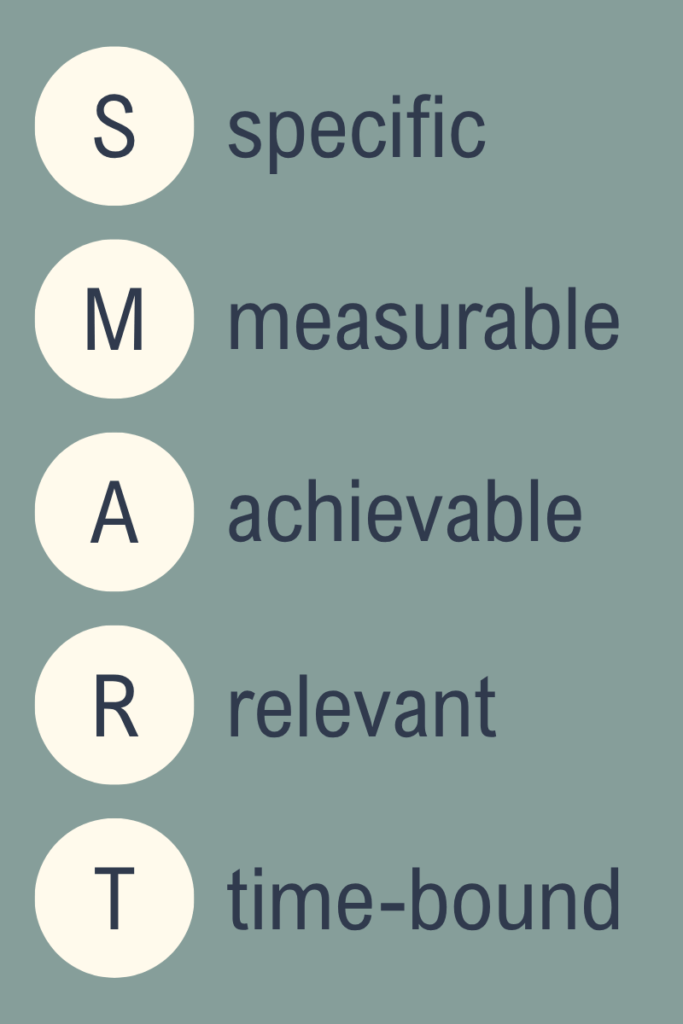
Breaking the SMART-or-nothing reliance that can limit growth and impact.
Yes, *that* SMART goal. The requisite structure we all have to use. An abstract framework created by a guy in the 80s.
A framework on which it’s shockingly difficult to find validating research.
It’s the method by which entire organizations and projects are structured and thus the thing that shapes and determines lives.
And I don’t think I’m being hyperbolic.
The SMART framework can be really useful, sometimes. And then there are other times when I’ve just begrudgingly put up with it because it was mandated by a funder or an agency.
An industry standard, but why?
SMART goals have permeated the development and social sectors for decades now.
But it was designed in the early 1980s to make industrial processes more efficient.
And while you might assume (like I did) that something so widely used across business, nonprofit and government sectors has been tested a million times over, it really doesn’t seem like it has, according to my experience with some quick research for this article.
So why is a SMART goal the baseline expectation for everything from business to community development?
My opinion: I agree with the assessment that goal setting delivers high levels of certainty and control, and people like that. The SMART framework is kind of the ultimate in defining certainty and control (Ness Labs).
This system can be good—it has been good. It’s especially useful for reigning in lofty, disparate, and at times completely unhinged expectations.
But I disagree that it’s always the most appropriate way to structure our definitions of success, i.e. our goals and objectives. Goal setting, and I believe this widely accepted framework in particular, can limit activity, motivation, and innovation and therefore, progress (Harvard Business School).
Among the issues with hyper-defined goals:
- There’s little room for flexibility and nuance
- Timelines are never what we plan for them to be, and trying to meet them can lead to cutting corners simply to make a deadline
- Goals often skew quantitative
- Learning opportunities can be limited
These issues culminate into one thing: Missing out on seeing and understanding the full range of impacts of our work (both positive and negative).
Here’s what I mean.
Reducing so much work into a few narrow SMART goals erases a lot of the bigger picture and we lose critical nuance. We also know plans can, and sometimes should, change, but people get stuck in the quest of checking off lists of achievements instead of focusing on more meaningful progress.
Additionally, these types of goals scream “efficiency”, and I would say we’re due for a serious conversation about the place of efficiency in social impact work, whether that’s in government or the private sector, for profit or nonprofit.
Simply put, we live in the messy, real world that is heavily influenced by politics, markets, microbes, and wars. We will never be factory-level efficient. TB and malaria patients aren’t factory widgets, nor are the healthcare providers treating them, and climate change mitigation doesn’t operate in a controlled setting.
This is not a call to throw caution and planning to the wind and waste money, but it is meant to push thinking about our duties and purpose in our work and realize how we’re not here to turn social investments into efficient machines with peak ROI. We have a dual aim here.
With such a heavy reliance on SMART goals and goal-setting in general, we also artificially constrain what we understand, learn, and see due to perceived and real limits to measurability and timelines that we’ve put on ourselves with this structure.
It’s also possible, and this is arguably the worst, that a goal is not set and an outcome is not measured because we don’t understand its potential in the first place and therefore it’s never accounted for.
So, what do we do instead?
- Use the SMART framework as a suggestive guideline, or only for some of your goals and objectives. Measure more than your pre-defined outcomes. Keep yourself and stakeholders grounded with some reasonable boundaries, but don’t get married to having everything super defined. Keep any use of the whole SMART acronym confined to really clear-cut goals (ex: provide doses of X for 95% of community Y by month 3), and don’t hold your entire monitoring and evaluation or IMM process hostage to this. Blend this goal-setting practice with other processes and methods. Otherwise, you’ll miss out on learning opportunities, and you’ll miss seeing things you weren’t looking for that could make huge differences.
- I like outcome harvesting for a lot of situations. It’s one tool in our kit of evaluation methods, and one I find is still underused. This is great to let the work speak for itself, and is inverse to the cause and effect, stepwise orientation we often mentally assign to our projects. With this, you can learn about outcomes you hadn’t anticipated in the planning phase.
- Don’t forget to use a participatory approach during planning. Make it easy for your target audience/community to engage with you and drive key components of the process. This goes as far as letting them define the goals in the first place. And if what stakeholders and community members suggest sounds kind of vague, don’t force a SMART correction. Not immediately, anyway. Let communities define the value (because goals are embodiments of value). This will also bring a lot of eyes and ears to your work, so remember this isn’t an existential threat, it’s a learning and trust-building opportunity. Start with focus groups, surveys, or consensus activities, and branch out to other means of engagement depending on everyone’s bandwidth.
Lastly, I understand there is a massive culture shift to make these things stick that’s frankly beyond any single person or organization’s control, but we have to start somewhere, and that somewhere is within our own circles, conversations, and practices.
How much do you use the SMART framework, and is not using it a little odd to you? How has it helped or hampered your project having an impact that’s meaningful to the groups you serve?