Sure, I admit I like a good consensus workshop (a *good* one!)
I used to think they were these fluffy, all-about-the feels wastes of time where the highlight might have been a free lunch, but having been a participant and facilitator at this point in my life, I have come around to see the benefit of getting everyone on the same page through a collective process.
We’ll touch on consensus building more in a second, because first we need to talk about your impact strategy’s building blocks.
Your Foundation. Since without that you have nothing to stand on.
Having identified a problem, whether it’s higher than average rates of malaria deaths or chronically slow economic development in certain communities, your next step should be a serious reflection on what to do about it using a series of methodically asked questions.
It’s easy to jump to the conclusion that you know what to do, “it’s obvious, right?” But is it? What does the evidence say about it?
Getting your impact strategy right means starting from a place of due diligence where we put in the work to learn about where and how to intervene.
So let’s get off on the right foot.
1. Start with a situational analysis and/or root cause analysis. Compass, furnisher of the links, offers some great guides.
The full process can be quite extensive, so I’ve highlighted what I consider to be the most critical actions below. (Keep in mind this part rarely means analysis like statistics; these are very accessible assessments/exercises).
- Write a clear problem statement, focusing on the immediate issue.
- Then, do a thorough literature review and conduct stakeholder interviews using why questions that are framed around the problem to elicit insight into causes further and further down the chain. A note: don’t skimp on the lit reviews—a lot of folks underestimate their benefit while trying to be “innovative” but that’s not always what you need. An effective intervention could be lurking in the literature just waiting for implementation.
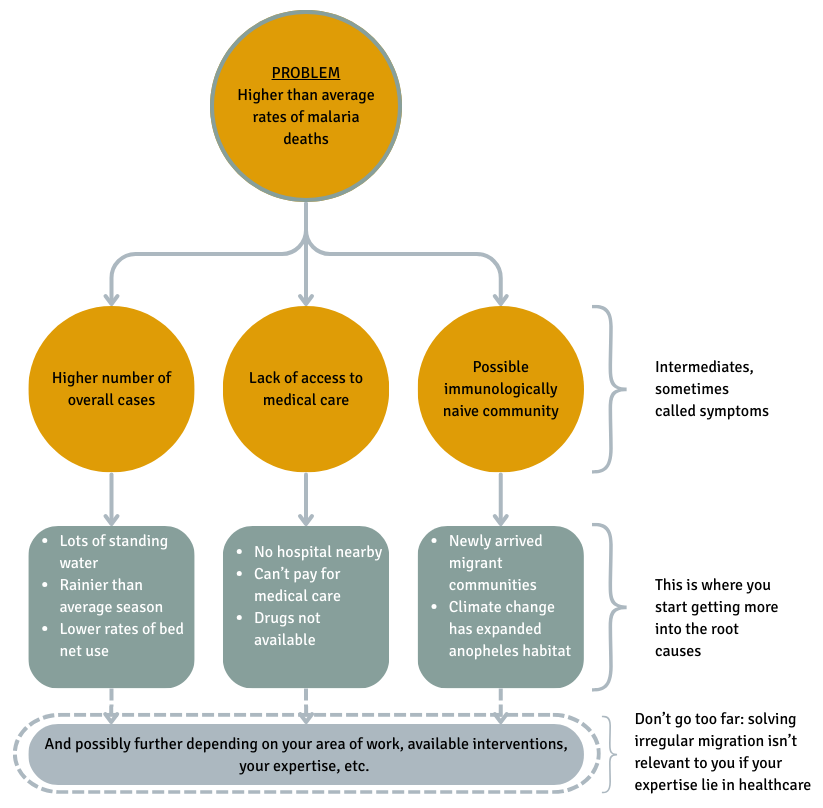
- You’ll need to organize the information you’ve learned using tables or diagrams, something simple like the image below works.
- Then, with stakeholders, you need to pick your intervention, summarize it, and share the plan and how you arrived at your strategy.
3. Once you have a good understanding of your general direction, find a good facilitator for a consensus workshop, or attempt it using a trusted colleague, to collectively define the detailed things like your goals, objectives, and maybe even outcome measures for your intervention. If needed, you can also use this exercise to define mission statements, bylaws, and guiding principles.
These workshops are really good for getting everyone in agreement and supportive of a unified strategy for your intervention. In addition, this process is transparent-with everyone witnessing the evolution of reaching said agreement-which I believe helps buy-in even more.
In my mind, the steps above don’t have to be ordinal nor are they all or nothing. Use any or all.
I’d just say two things: keep the components of #1 together, and more or less in that order. And save defining goals, objectives, and outcome measures for AFTER you have identified your intervention. (If you’re in the middle of a program or intervention, it’s still possible to do these activities, too, and adapt as needed.)
Have you tried any of these tools for identifying and planning your impact strategy or implementing projects? Let me know.