Old-School Tools to Frame Your Learning
Getting started with any learning process (research, analysis, impact measurement and evaluation are all learning processes) that involves collecting and analyzing information means thinking through the how. How will you tangibly accomplish your learning goals? i.e., how will you answer your research and/or evaluation questions?
Somewhat simply, learning happens by asking questions, collecting information, and then doing something with it in a way that yields insights.
For some, any resulting analysis won’t be complex, nor does it have to be done all the time. Many organizations will use complex methods to arrive at some conclusions, form associations between two things, or statistically link cause and effect.
These things are great. And often necessary depending on your original questions and the extent of the project at hand.
But not everyone or every organization needs or is able to start with more complex analyses. Those will come with time, experience, and building up internal capacity or tapping a capable partner or stakeholder.
Regardless of the level of complexity in your analyses, we all should start with good systems and process prep before we jump into the meat of conducting any evaluative or research process.
The Scientific Method Still Works
Think back to the Scientific Method from school, because its application goes beyond the chemistry lab. We can also use it to guide our work for learning in an evaluation or programmatic capacity, too.
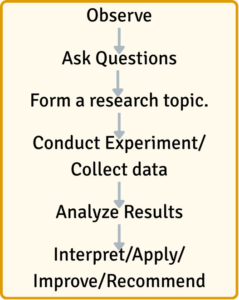
Here’s an easy breakdown of each piece of the process.
Your observation: Your program appears to serve people in different ways than originally planned, and this is challenging for staff.
So you ask questions: How is this program currently serving the needs of the community? Does this align with the original aims, organizational strengths, and goals?
To answer those questions, choose your methods: Through analysis of client records and surveys, assess how the community interacts with your organization and what services they’re seeking. Do an alignment check to see if this is what you set out to do and what you’re equipped to do.
Then you collect data to answer your questions: Using accessible tools across 1-2 mediums, deploy that survey to collect additional needed data, and compile your client records if not already in an analyzable format (like excel or other table) to look at past services to clients.
Then you analyze the resulting data: Compile, clean, review, analyze, and visualize relevant to your original questions! Don’t lose sight of what you set out to initially learn. You can of course look at more, but make sure you don’t forget why you started this in the first place.
Use those results to take action: Sharing findings with stakeholders and seeking feedback, what do you need or want to change in light of what you’ve learned? Did you find in your data that most of your community members seek social services when you’re structured more as a medical clinic? Or that you’ve morphed into an economic development engine when you originally set out to address food insecurity? Does your staff need training to meet different community needs or does your organization need to pivot?
Repeat the Above Steps for Continuous Improvement
Once you’ve shared findings with stakeholders and sought feedback, keep up the work by making the above steps routine. In your findings and subsequent conversations you may have decided you need to hire different people, seek funding from a different source, or build new partnerships to better serve your community.
To keep monitoring the progress and impact of any changes, implement data and learning feedback loops in your learning process. Don’t forget to include how often you’ll collect new information, from whom, what type of information you’ll collect, and who will do that work. Write these things down and stick to it. This process and any corresponding documents (*I suggest you make this into a document for your team) will be a great guiding reference and can later serve as a reflection piece when you’re doing any after-actions or reviews as parts of your longer term data collection or evaluation process.
What are the actual tools and techniques needed to implement a good learning process?
They can be high or…not so high tech. It could mean using Excel, Google Sheets, or any of the 100s of survey tools available. You can even use old fashioned pen and paper if that’s what suits you best, because sometimes (believe it or not, in 2026) paper and a clipboard still work best for some organizations in certain settings. This is where knowing your audience and setting is key.
If collecting interviews or taking photos (which we love) you’ll also need some sort of recording device, whether an old-school dictaphone or a secure recording app you download on your phone or tablet.
Spend time learning how to use these things before you solidify any research or evaluation process so you’re familiar with the limitations and can plan well and insure you’ve got the right tool (which is why all of this is considered prep!)
Lastly, I’ll just note that more advanced analyses using these tools are taught in graduate level classes so a lot of organizations won’t be able to just jump in and do them.
But fear not—there’s a lot to learn with more basic methods plus plenty of free resources online (including vetted YouTube videos and free, basic courses from academic institutions) to advance bit by bit. Basics like calculating sums and percentages using formulas, how to be a good survey enumerator or interviewer, researchers’ favorite software for recording interviews, and how to create basic graphs and visualizations for making sense of a spreadsheet full of data can all be found online from reputable sources.
As of this writing in 2026, please do not try to use AI for these things if you don’t know how to check for validity and to debug any code. There are still too many errors, and even highly trained people have missed them and released errant information.
And remember, if this is overwhelming for your internal team, seek outside help on the front-end!
As you gear up and prep for your programmatic learning activities, let us know how things progress. What roadblocks are you running into? Have you had any a-ha moments already? Comment and tell us.