Most people talk about using their results, but it doesn’t always happen. Regardless of the type of learning and evaluation journey you’re on, feedback loops are possibly your missing ingredient to greater impact.
I’m a firm believer that everyone can and should plan for and benefit from evaluation in all its stages and forms, from needs assessments, monitoring, and process evaluation to assessing impact (and many places in between). To me, this is just part of making sure your work is…well, working.
The one key component of all of them that is frequently lacking is feedback loops. Too often organizations fall into the trap of collecting and analyzing data but then doing not very much with it beyond writing up a report and maybe talking about it at a meeting.
Easily Incorporate Feedback Loops Into Your Systems
In the stages of preparing your project or program to be data-driven and well-prepared to conduct any kind of MEL or CQI process, you’ll be thinking about a lot, but you should include these 4 things:
- What is my program/project meant to do? (Goals, activities, OUTCOMES)
- What do I want to learn about my program/project? (Aka, your key questions.)
- What are my data and learning processes and systems going to look like so I can answer my key questions?
- How am I going to use the information I collect to learn about my work and make improvements?
So start with your key questions alongside your previously drafted goals, activities, and outcomes (ideally, you’d have these already done since you’ve got funding or are on the cusp of getting it to have made it to this point).
What is it that you’re wanting to learn about and know over the short and long term of this work/project? Write these down.
Once you have a good idea of the questions you have, i.e. what you want to learn about, then start drafting out the kind of data and processes you need to answer those questions.
This will help you choose your processes way better than any matrix or table that explains evaluation types ever will, because, frankly, there are a thousand ways to “do” evaluation (and what makes it so interesting and adaptable, in my humble opinion). Craft a process and choose tools that works for you, your questions, your beneficiaries and your community.
Then incorporate your feedback loops into and around these processes and tools. These mechanisms that provide you with feedback should: seek/compile information, share that information, and do something with that information. These are the basic essences of feedback loops and an absolutely critical piece to making your evaluation work worth it.
A Process Visual for Incorporating Feedback Loops
This is what a few feedback loops can look like (follow the yellow and dotted lines, and yes, they blend with the overall evaluation process):
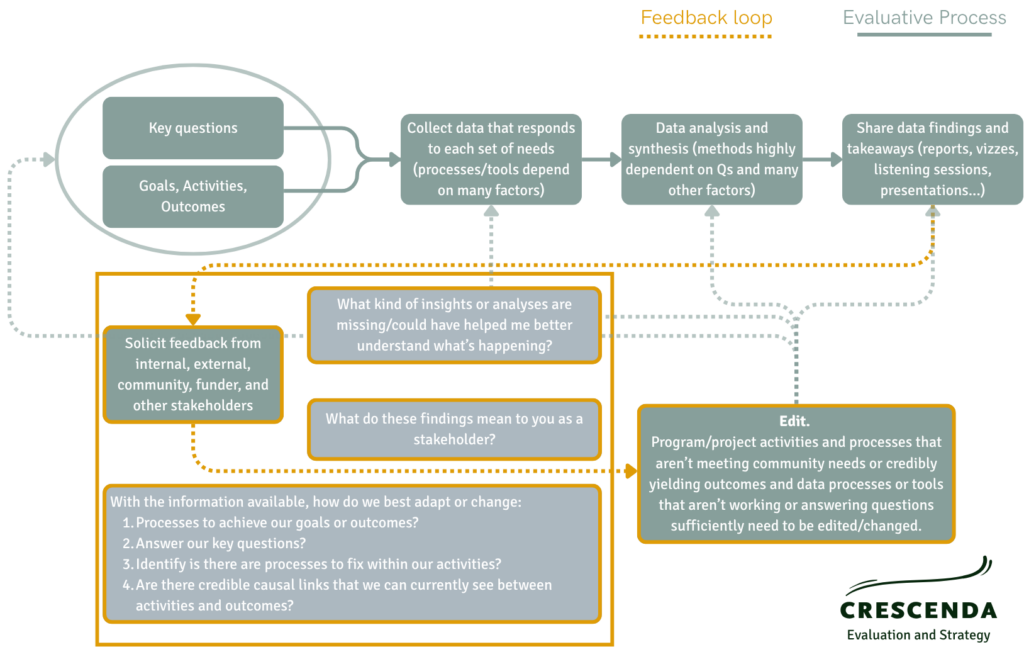
This process is meant to be iterative and adaptive, so don’t get stuck on this one pathway or the steps. There could be more steps you incorporate and that’s great. What matters is finding what works for you and your stakeholders to get real input from your findings back into your work and its processes.
Feel free to download this image and share it with others and use it in your work!
How are you learning from your work currently? Are any of these pieces missing? Do you have other roadblocks? Let me know!